


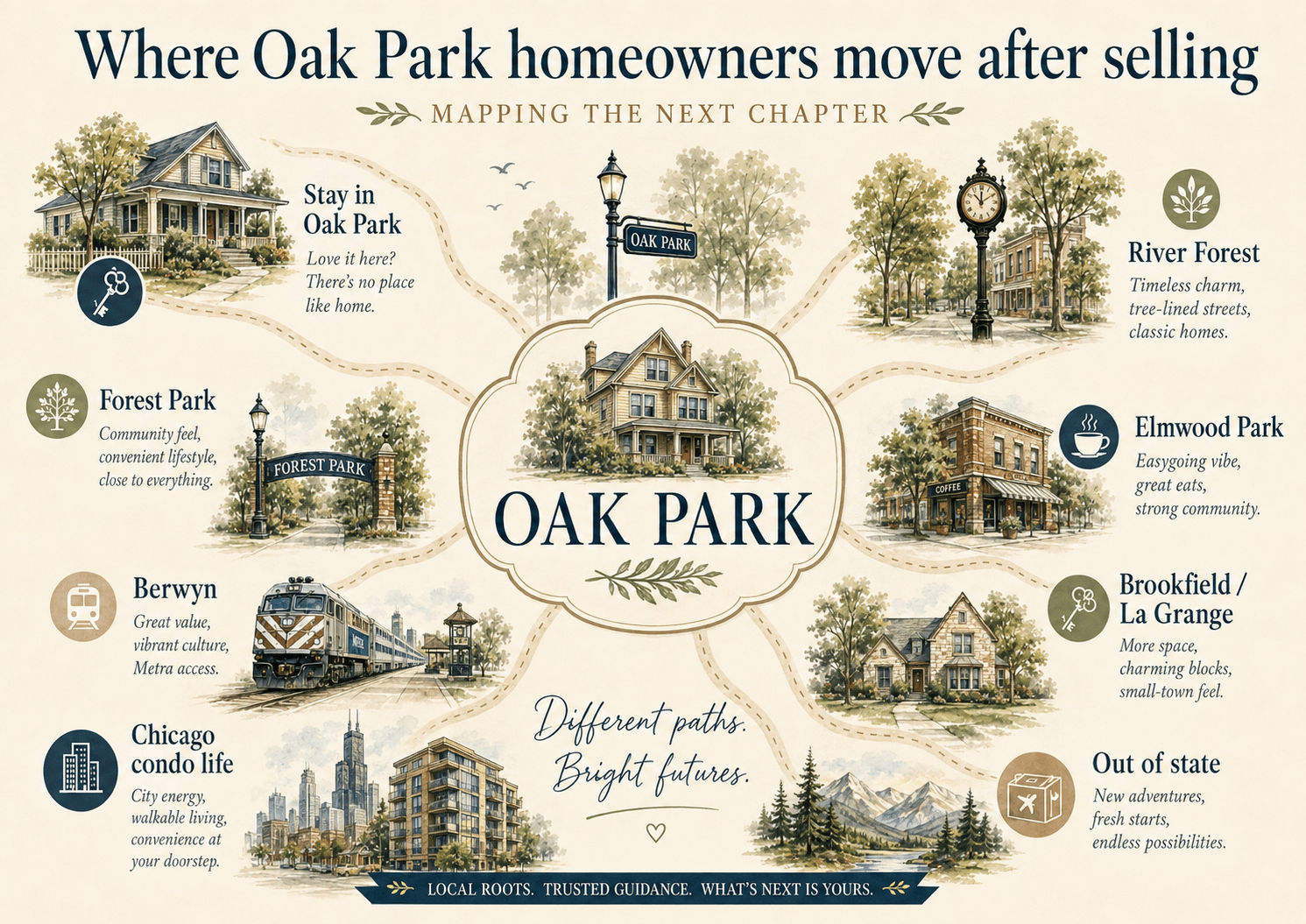
Where Oak Park Homeowners Move After Selling
For longtime Oak Park homeowners, the hardest question is not always “Should we sell?” Sometimes it is, “Where would we actually go?”
There’s a moment I see happen with homeowners all the time.
Not at the closing table. Not when the sign goes in the yard. Not even during the pricing conversation, although that one can certainly bring out everyone’s inner spreadsheet goblin.
It happens earlier. Quieter.
Usually at a kitchen table, in a living room, or standing somewhere near the stairs they have quietly started to resent.
The question is not always, “What is my house worth?”
It is: “If we sell this house… where do we actually go?”
And that question is a lot heavier than it sounds.
Because selling a longtime home in Oak Park is rarely just about real estate. It is about identity, routine, memory, family logistics, aging, maintenance, money, freedom, grief, relief, and sometimes the very specific realization that you no longer wish to be personally responsible for every gutter, basement mystery, and tree root with an agenda.
A house can be beloved and too much.
A house can be valuable and no longer practical.
A house can hold your whole history and still not fit your next chapter.
That is the part people do not always know how to say out loud.
We talk a lot about home value. We do not talk enough about life value.
Real estate marketing loves the question, “Do you know what your home is worth?”
And sure, that matters. Of course it does.
But for many Oak Park homeowners, especially empty nesters, downsizers, retirees, and people in a major life transition, the bigger question is:
What would make life feel better now?
Not ten years ago. Not when the kids were small. Not when the yard felt manageable. Not when you were still thrilled by the “charm” of a 100-year-old house with strong opinions.
Now.
Do you want fewer stairs? Less yard? A smaller footprint? More walkability? An elevator? Indoor parking? A condo where someone else handles the snow? A quieter suburb? A livelier city neighborhood? A guest room for grandkids? A building with fewer surprises?
The next home is not just a smaller version of the old home. The next home should be designed around the next version of your life.
That might mean staying in Oak Park. It might mean moving nearby. It might mean heading into Chicago. It might mean leaving Illinois entirely. There is no one right answer. But there are patterns, and understanding those patterns can make the whole decision feel less overwhelming.
If you are just starting to think through the selling side, you may also want to explore my home selling resources and my guide to downsizing in Oak Park and the near west suburbs.
Staying in Oak Park, but changing the lifestyle
Some Oak Park homeowners sell one house and buy another right here in the village.
That might mean moving from a larger vintage home into a condo, townhome, smaller house, or a property with fewer stairs and less yard. For people who love Oak Park’s walkability, architecture, restaurants, parks, library, CTA and Metra access, and general “I ran into three people I know at the farmers market” energy, staying local can be incredibly appealing.
But downsizing in Oak Park is not always as simple as “sell the big house, buy the small thing.”
Inventory can be limited. Elevator buildings, first-floor bedrooms, attached garages, pet-friendly condos, and truly low-maintenance homes are not always easy to find. And depending on your current home, the math may not be as dramatic as people expect once taxes, HOA fees, updates, moving costs, and lifestyle needs are factored in.
Sometimes staying local is the right answer. Sometimes it is not. The point is to separate the feeling of “I love Oak Park” from the very practical question of “What kind of home will actually make my daily life easier?”
That does not mean it is impossible. It just means the plan matters.
You can start browsing current options here: Oak Park homes for sale.
The emotional math is real
There is financial math in a move.
Sale price. Purchase price. Mortgage rates. Taxes. HOA fees. Repairs. Closing costs. Moving costs. Insurance. Timing.
That math matters.
But there is also emotional math.
The cost of staying in a house that no longer works. The stress of maintaining too much. The grief of leaving a place that holds decades of memory. The relief of simplifying. The fear of making the wrong move. The strange guilt of wanting something easier.
People often beat themselves up for feeling conflicted.
But conflict is normal.
A longtime home is not just shelter. It is a container for eras of your life.
Selling it can feel like closing a chapter even when you are the one ready to turn the page.
Maybe the house feels too big now. Maybe the stairs are becoming annoying. Maybe the yard used to be a joy and now feels like a second job. Maybe the kids are grown, but their stuff somehow still lives in your basement like it pays rent.
Maybe you are not ready to sell, but you are ready to understand your options.
That is normal.
A good real estate plan should not begin with “let’s get this on the market.” It should begin with:
- What do you want daily life to feel like?
- What do you want to stop maintaining?
- What do you still want access to?
- What kind of home would actually make life easier?
- What needs to happen before you can move without feeling like you are detonating your whole life?
Selling is a transaction. Moving on from a longtime home is a transition. Those are not the same thing.
The Zillow spiral is not a plan
When people start wondering where they might go next, they often do what every modern human does when faced with a major emotional and financial decision:
They open 47 tabs and call it research.
A condo in Chicago. A ranch farther west. A townhouse near the train. A cottage near family. A house in another state. A wildly impractical dream property that somehow made it into the search because it had nice light and a screened porch.
This can be fun for about twelve minutes.
Then it becomes chaos.
Because listings answer the wrong question first.
Listings ask how many bedrooms, how many bathrooms, what price range, what town, and what square footage.
Useful, yes. But not the starting point.
The better starting question is: what are we solving for?
- What do you want to stop maintaining?
- What do you not want to give up?
- How much privacy do you need?
- How important is walkability?
- Do you need one-level living?
- How much outdoor space do you actually want to care for?
- What do you need near you?
- How much community do you want?
- How much uncertainty can you tolerate during the move?
- Would temporary housing make this less stressful?
That is the work before the search.
Otherwise, you are not looking for a home. You are browsing possible identities. Which, to be fair, is very human. But not always productive.
If you are an Oak Park homeowner wondering where you would go after selling, you do not have to figure it out alone. We can look at your current home, your likely sale range, your ideal next lifestyle, and the realistic options nearby or farther out.
Before you scroll listings, map the next chapter.
I also wrote a broader reflection on this topic over on Substack: The Hardest Part of Selling a Home Isn’t Always the Sale. It digs into the emotional math of leaving a longtime home, the very real Zillow spiral, and a simple three-column exercise to help you sort through what you want to keep, what you want to stop dealing with, and what you are actually open to changing. Sometimes the most helpful first step is not browsing listings. It is getting honest about what kind of life you want the next home to support.
Thinking about selling your Oak Park home?
You do not need to be ready to list next week to start having a smart conversation.
In fact, it is usually better if you are not.
I work with homeowners throughout Oak Park, River Forest, Chicago, and the near west suburbs, including sellers who are downsizing, moving closer to family, leaving Illinois, buying their next home, or simply trying to figure out what comes after the house they have loved for years.
The first conversation does not have to mean you are ready to sell. It can simply help you understand what is possible.
Start here:
- Selling a home in Chicagoland
- Downsizing in Oak Park and the near west suburbs
- How to sell without getting stuck
- Buying your next home
- Oak Park homes for sale
- River Forest homes for sale
- Forest Park homes for sale
- Elmwood Park homes for sale
- Berwyn homes for sale
- Chicago condos for sale
No pressure. Just clarity.
Call or text: 630-248-1976
Email: laurie@OPRFhomesforsale.com
Website: OPRFhomesforsale.com